

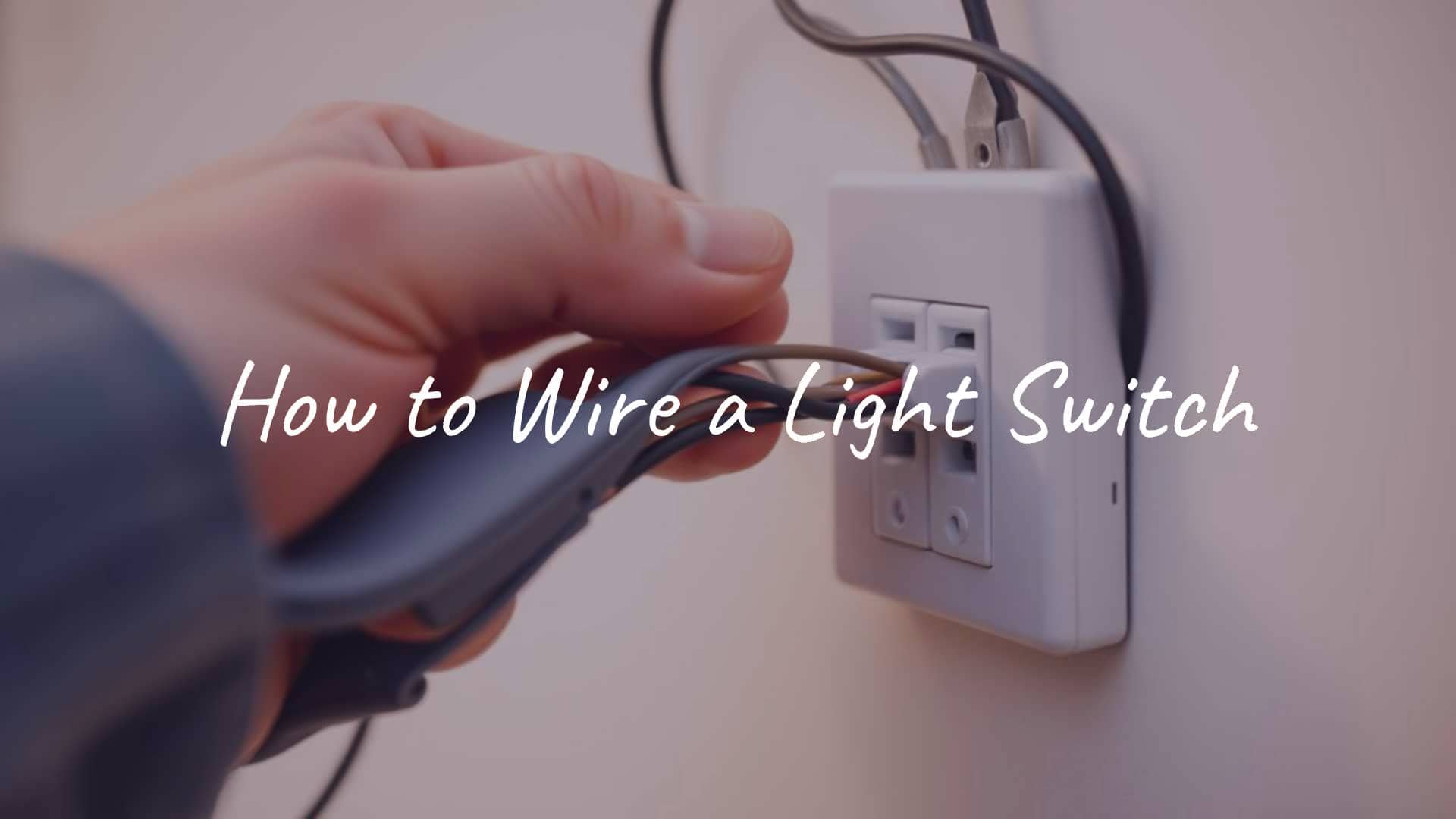
Light switch wiring is the basic process of connecting electrical wires to a switch so you can safely turn a light on and off. A light switch acts like a gate in the circuit: when it is on, it closes the path and lets electricity reach the light; when it is off, it opens the path and stops the flow. While the idea is simple, you still need careful work when identifying hot, neutral, and ground wires so the setup is safe and works properly.
Learning how light switch wiring works is very helpful for any homeowner or DIY person who wants to update or repair their home. Whether you are swapping out a broken switch or adding a dimmer, knowing how power moves through your walls gives you more control and confidence. It combines hands-on work with basic electrical theory and can be the difference between a flickering light and a steady, reliable system.

What Is Light Switch Wiring?
What Are the Main Types of Light Switches?
For home wiring, there are several main kinds of switches. The most common is the single-pole switch. This type controls one light (or set of lights) from a single location. You usually find them in bedrooms, bathrooms, closets, and small rooms. They often have “On” and “Off” printed on the toggle and have two brass screw terminals for the hot wires.
The next level is three-way and four-way switches. A three-way switch lets you control one light from two different spots-such as at both ends of a hallway or at the top and bottom of a staircase. These do not have On/Off markings, because the light’s state depends on the position of both switches together. Four-way switches are used along with two three-way switches so you can control one light from three or more locations. These are useful in long hallways, large rooms, or multi-entry spaces.

How Does a Light Switch Control a Circuit?
A light switch works by interrupting the hot wire, which carries power from the breaker panel to the light. In the “off” position, the switch opens a gap inside so the current cannot reach the fixture. In the “on” position, the internal parts touch and let current pass through to the light.
A standard light switch normally does not connect to the neutral wire. The neutral wire usually passes through the box and goes straight back to the panel to complete the circuit. The switch’s job is to control only the hot side. This “switch the hot wire” rule is a key safety practice, so when the switch is off, the light socket does not have live voltage.
Safety Precautions for Light Switch Wiring
Why Should You Turn Off Power at the Breaker?
Safety comes first with any electrical work. Turning the wall switch off is not enough to make the wires safe to touch. Even if the light is out, the wires in the box can still be live and dangerous. If you touch a hot wire while your body provides a path to ground, you can receive a serious or deadly shock.
Shutting off the circuit breaker at the main service panel cuts that part of the house wiring off from the power source. This way, the wires you are working on should be dead. Put a piece of tape over the breaker or leave a clear note on the panel so no one else turns it back on while you are working.
DANGER: Electrical work in progress.
Do NOT turn on.
How to Use a Voltage Tester Before Wiring
Do not assume the power is off just because you flipped a breaker. Panel labels are often wrong or out of date. A non-contact voltage tester is the safest way to check. This pen-style tool senses electrical fields through the insulation without touching bare metal.
Before disconnecting any wires, put the tester’s tip into the box and move it near each wire. If it beeps or lights up, the wire is still live. A good habit is to follow this “live-dead-live” routine:
- Test the tool on a known live outlet to confirm it works.
- Test the wires you plan to work on; they should test dead.
- Test the known live outlet again to confirm the tester is still working.
What Are the Electrical Code Requirements for Light Switches?
The National Electrical Code (NEC) sets rules for safe electrical work. One major rule in newer codes is that a neutral wire should be present in most switch boxes. Older homes often used “switch loops” that only brought hot wires to the box. Modern smart switches and dimmers usually need a neutral for their electronics, so upgrades may require running a new cable with a neutral conductor.
The code also requires that all metal boxes and switches be properly grounded using a bare copper or green wire. Another rule is “box fill” capacity: each box is rated for a certain number of wires and connectors. Overfilling a box can trap heat and increase fire risk.
Which Tools and Materials Are Needed for Light Switch Wiring?
Recommended Tools
To do neat, reliable wiring work, you need a few basic tools:
- Wire strippers – to remove insulation without cutting into the copper.
- Multi-bit screwdriver – Phillips and flathead tips for terminal screws and wall plates.
- Needle-nose pliers – to bend wire into hooks for screw terminals.
- Linesman pliers – helpful for cutting and twisting wires together.
- Non-contact voltage tester – a key safety tool, not optional.

Having these tools ready nearby saves time and avoids mid-project trips to the toolbox or garage.
Common Wiring Materials
Besides the switch itself, you may need:
- Wire nuts or lever-style connectors (such as Wago) for joining wires.
- Electrical tape for wrapping around terminal screws if you want extra insulation.
- Pigtails – short wires used to extend or split connections when existing wires are too short.
| Circuit rating | Typical wire size |
|---|---|
| 15 amps | 14-gauge copper |
| 20 amps | 12-gauge copper |
Match the wire gauge to the circuit rating. Finish the job with a new wall plate for a clean look.
How to Wire a Single-Pole Light Switch
Identifying Electrical Wires
When you pull out a switch, you may see several wire colors. In a typical North American setup:
- Black – hot (carries power from the panel).
- White – neutral (return path), though in some older switch loops it may be used as hot and should be marked with black tape.
- Green or bare copper – ground.
For a simple single-pole switch, you will usually have two hot conductors (two blacks, or a black and a red). One is the Line (power coming in) and the other is the Load (going to the light). For a basic mechanical switch, either hot wire can go on either brass screw, but smart switches often require the Line and Load on specific terminals.
Steps to Replace a Single-Pole Switch
- Turn off the power: Shut off the correct breaker and confirm with a voltage tester.
- Remove the old switch: Take off the wall plate and mounting screws, then carefully pull the switch out.
- Disconnect the wires: Loosen the side screws and remove the wires. If wires are pushed into back-stab holes, release them with a small screwdriver or cut and re-strip them.
- Prepare the wires: Strip about 3/4 inch of insulation and bend each wire end into a small hook with pliers.
- Connect the new switch: Attach the ground to the green screw. Attach the two hot wires to the two brass screws. Hooks should face clockwise so tightening the screw pulls them in.
- Finish up: Gently fold the wires into the box, fasten the switch, and install the wall plate.
Single-Pole Switch Wiring Diagrams
Imagine a simple loop: power comes into the box on a black wire and connects to one brass screw on the switch. Another black wire goes from the other brass screw to the light. The white neutral wires in the box are tied together with a wire nut and do not touch the switch. All ground wires are connected together and to the green screw on the switch (and to a metal box, if one is present).
# Single-Pole Switch Connections
Line Hot In -> Brass Screw 1
Load Hot Out -> Brass Screw 2
Neutral Wires -> Connected together (bypass switch)
Ground Wires -> Green Screw & Box
How to Wire a Three-Way Light Switch
What Is a Three-Way Switch and Where to Use It?
A three-way switch always works as part of a pair. It lets you turn one light on or off from two different places. Common spots include both ends of a hallway or both ends of a stairway. A three-way switch has three terminals plus a ground: one Common (usually a darker screw) and two Traveler terminals.
With this setup, flipping either switch changes whether the circuit is open or closed. You can control the light from either location, which adds comfort and safety so you do not walk through darkness to reach a switch.
Steps for Three-Way Switch Installation
To wire a three-way switch, you must identify the Common wire. On one switch, the Common usually brings power from the panel. On the other switch, the Common usually goes to the light. The other two wires between the switches are the Travelers.
Basic connection order:
- Connect the ground wire to the green screw.
- Attach the Common wire to the darker-colored screw.
- Attach the two Traveler wires to the remaining brass screws (order does not matter).
Repeat this at the other three-way switch, making sure you place the Common on the dark screw and the Travelers on the brass screws.
# Three-Way Switch Connections
Common Wire (Line or Load) -> Common (dark) Screw
Traveler Wire 1 -> Traveler Screw A
Traveler Wire 2 -> Traveler Screw B
Ground Wire -> Green Screw
Three-Way Switch Wiring Diagrams
Picture two switches with two wires running between them. Power enters the Common terminal of Switch A. Two Traveler wires connect Switch A to Switch B. The Common terminal of Switch B connects to the light. If both switches connect to the same traveler at the same time, the path is complete and the light comes on. If they connect to different travelers, the path is broken and the light is off.

How to Wire a Four-Way Light Switch
Where Are Four-Way Switches Used?
Four-way switches are used when you need control from three or more locations. A four-way switch is always placed between two three-way switches. You might see this in large open rooms, long corridors with several entries, or staircases with multiple landings.
A four-way switch has four terminals plus ground. It “crosses over” or passes through the pair of traveler wires that come from the three-way switches, allowing the light to be turned on or off from any switch in the chain.
Steps for Four-Way Switch Wiring
Wiring a four-way switch means handling two separate pairs of travelers:
- One pair from the first three-way switch.
- One pair going to the next switch (either another four-way or the final three-way switch).
Many four-way switches are labeled “IN” and “OUT” or use color coding for each pair. Connect the ground first. Then:
- Attach one traveler pair to the top two screws.
- Attach the other traveler pair to the bottom two screws.
Do not mix the pairs. If you connect one wire from each pair on the same side, the circuit will not work correctly. Once wired, gently fold the wires into the box; four-way switches are often larger and need extra space.
# Four-Way Switch Connections
Traveler Pair 1 -> Input Terminals (e.g., Top Screws)
Traveler Pair 2 -> Output Terminals (e.g., Bottom Screws)
Ground Wire -> Green Screw
How to Replace a Standard Switch with a Dimmer
Types of Dimmer Switches
Dimmers come in several styles:
- Rotary dimmers – round knobs that you turn.
- Slide dimmers – small levers you slide up and down.
- Toggle dimmers – look like normal switches with a side slider.
- Digital dimmers – may have touch pads, buttons, or app control.
Match the dimmer to the bulb type. A dimmer made for incandescent bulbs often causes LED bulbs to flicker or buzz. For LED or CFL bulbs, choose a dimmer labeled for dimmable LEDs/CFLs (often marked CL) to get a smooth dimming range.
Steps for Dimmer Switch Installation
Most dimmers install much like standard switches, but many use attached wire leads instead of screw terminals.
- Turn off the breaker and confirm the power is off with a tester.
- Remove the old switch and disconnect its wires.
- Use wire nuts to join the dimmer’s leads to the house wires:
- Green lead to ground.
- Black or red leads to the hot wires (Line and Load).
- If you have a three-way dimmer, connect the extra colored lead (often red) as the instructions show. One device is usually the “master” and the other is the “companion” or “remote.”
# Dimmer Switch (Single-Pole) Connections
Dimmer Green Lead -> House Ground Wire
Dimmer Hot Lead 1 -> House Line Wire
Dimmer Hot Lead 2 -> House Load Wire
Dimmer Switch Wiring Considerations
Many higher-wattage dimmers have metal fins on the sides called heat sinks to get rid of heat. If you install more than one dimmer side by side in the same box, you may need to break off some fins, which lowers the maximum wattage the dimmer can handle. Check the dimmer’s instructions and packaging for exact wattage limits and adjust your bulb count if needed so the device does not overheat.
Troubleshooting Common Light Switch Wiring Problems
Switch Not Working After Wiring
If the light does not turn on, check the breaker first. If the breaker is on and not tripped, the most common issue is a loose connection. A wire that is not tight under a screw or inside a wire nut can open the circuit. Open the box and gently tug each wire to see if it is secure.
For three-way setups, another frequent problem is swapping the Common wire with a Traveler. This often leads to a light that only works in certain switch positions. Recheck the wire going to the dark screw on each three-way switch and move it if needed.
Flickering or Buzzing Lights
Flickering is very common when dimming LED bulbs with a non-matching dimmer. This usually means the dimmer and bulb electronics do not work well together. Choosing a dimmer rated for dimmable LEDs and using quality bulbs usually fixes the problem. If you see flicker with a basic switch, you may have a loose neutral connection or a failing light socket.
Buzzing can come from bulb filaments or the electronics inside LED bulbs. Using fewer bulbs on the same dimmer or picking “rough service” bulbs that handle vibration better can help. If the switch or dimmer itself buzzes loudly or feels hot, shut off the power right away. This could mean an internal fault or overload.

Preventing Wiring Errors
A simple way to avoid mistakes is to take clear photos of the existing wiring before you disconnect anything. You can also label each wire with masking tape (for example, "Common", "Traveler 1", "Line"). Avoid using the push-in “back-stab” holes on cheap switches; these often loosen over time. Use the side screw terminals for a stronger, long-lasting connection.
Frequently Asked Questions About Light Switch Wiring
Can a Three-Way Switch Be Used as a Single-Pole Switch?
Yes. If you only have a three-way switch on hand, you can wire it to work like a single-pole. Connect the power-in wire to the Common terminal, and connect the load wire to just one of the traveler terminals. Leave the other traveler terminal unused. The switch will work, though the on/off position may feel reversed depending on which traveler you used.
# Using a 3-Way Switch as a Single-Pole
Line Hot In -> Common Terminal
Load Hot Out -> One Traveler Terminal
Unused Traveler Terminal -> No Connection
Ground Wire -> Green Terminal
Are Neutral Wires Needed for All Switches?
Standard mechanical flip switches do not need a neutral in the box; the neutral only needs to reach the light fixture. But smart switches, motion sensors, and many modern dimmers do need a neutral. They draw a small amount of power at all times for their electronics, and they use the neutral to complete that internal circuit.
What Does Each Wire Color Mean in a Light Switch?
Color codes can vary, but typical rules are:
- Black – hot (line or switched hot).
- Red – hot (often travelers or second switched hot).
- White – neutral (return path to the panel).
- Green or bare copper – ground (safety path for faults).
Always test wires yourself, especially in older homes where previous work may not follow standard color rules.
Home lighting controls are changing quickly. More systems now use wireless remotes and smart bulbs that do not need extra in-wall wiring, using signals like Bluetooth, Wi-Fi, or Zigbee. Some high-efficiency buildings are also starting to use low-voltage DC lighting, which may change how future circuits are wired. Staying aware of these trends helps you plan upgrades so your switches and wiring keep working well with new technology, linking old electrical ideas with modern smart-home features.











![What to with Scrap Metal? [infographic]?](https://facts-homes.com/wp-content/uploads/2019/07/645413-POPYOV-391-120x86.jpg)